
Yellow-billed Hornbill
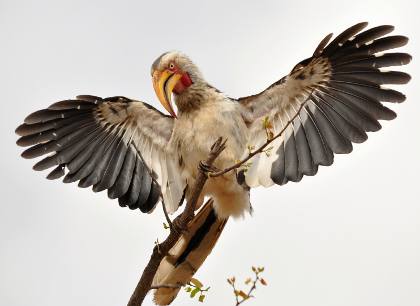
There are two species: the Eastern Yellow-billed Hornbill and the Southern Yellow-billed Hornbill. As the name suggests, these birds are found in the corresponding southern and eastern regions of Africa.
Habitat
There are two types of the yellow-billed hornbill: the eastern and the southern. As the name suggests, these birds can be found in the corresponding southern and eastern regions of Africa. However, the eastern yellow-billed hornbill can also be found in other parts of Africa, such as North-West Africa and West Africa. It lives in subtropical and tropical low-rainfall areas, forests, savannas and grasslands. It mainly lives in trees, where it also finds its food.
Diet
The yellow-billed hornbill is actually an omnivore. Its diet includes insects, short-horned grasshoppers, termites, spiders, small rodents and reptiles. Eggs and chicks of other birds as well as carrion of rodents also count among its meals. It only consumes a small amount of plant-based food, which it finds on trees and shrubs.
Behavior and Appearance
The yellow-billed hornbill is a medium-sized bird that can reach a body length of up to 55 cm. There is hardly any difference between the sexes. The only difference is that the females have a shorter beak. The beak is long and orange-yellow. The birds usually become sexually mature after two to three years. The mating season takes place at different times. In eastern and western Africa, it occurs from January to April, while in southern Africa it takes place from August to December. The yellow-billed hornbill builds its nest in one of the hollows of a tree. The female incubates there for two to three months, hatching three to four eggs. During this time, the male supplies her with food. The fledglings remain in the cavity for one to two months. Once the fledglings have left the nesting site, they still stay with their family group for some time.


