
White-backed Vulture
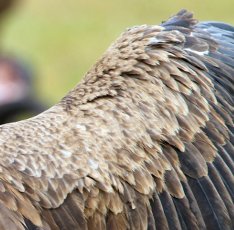
The remaining feathers are rather uniformly brown or reddish-brown. In addition, the head and neck are covered with light down that does not hinder the bird while feeding. In this respect, females do not differ from males in terms of feather coloration.
Appearance
The remaining feathers are rather plain brown or reddish-brown. Additionally, the head and neck are covered with light down, which does not hinder the bird while eating. In this regard, females do not differ from males in terms of feather coloration or body measurements. On average, they have a wingspan of 200 to 230 centimeters, with a body length of up to 90 centimeters. Depending on body size and wingspan, the White-backed Vulture can weigh up to 7.5 kilograms.
Behavior
Where are White-backed Vultures most commonly found? These large birds primarily live south of the Sahara. Particularly worth mentioning are East and West Africa, but this vulture species can also be found in Southern or Central Africa. They prefer landscapes with sparse tree cover, as well as open grasslands or savannas. Above all, there should be sufficient food and water for the birds, which is usually the case near large herds of mammals. Often, the vultures are also found in the vicinity of nomadic tribes, where there is plenty of food scraps available.
Diet
The main diet of White-backed Vultures, as is typical for vultures, consists of carrion from large mammals. When there is a large carcass, many of these birds can quickly gather, often leading to disputes over food. To avoid the heat of the day, they begin their search for food early in the morning, circling over a large area and scanning for carrion with their sharp eyes. These birds can also gather at watering holes, especially during the dry season, where large groups of White-backed Vultures can be observed, though they disperse again after the season ends.


