
Marabou
Even more impressive than its size is its wingspan, which can reach up to 300 centimetres, allowing the bird to cover long distances without much effort.
Appearance
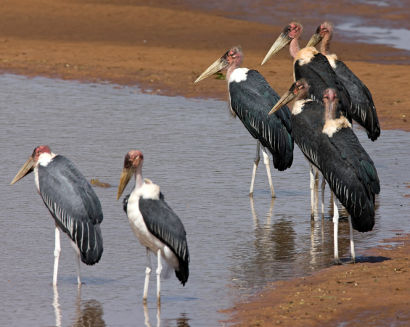
Even more impressive than its size is its wingspan, which can reach up to 300 centimeters, allowing the bird to cover long distances without much effort. A distinctive feature of the marabou stork is its neck, which is only lightly covered with down and displays colorful skin. Its head and yellowish beak can also exhibit many colorful spots, giving the bird a colorful appearance. In contrast, the rest of its body, with its black-and-white coloring, is rather dull, although the feathers on its back and the upper side of its wings have a green sheen. Lastly, the characteristic throat pouch, which is red in color, should be mentioned. When it is mating season and the males want to impress the females, the red color of the pouch becomes more intense.
The lifestyle and habitat of the marabou stork
This species of stork usually lives in groups of up to twelve birds that share a common roost and go out foraging together. The marabou primarily feeds on carrion, which it can easily tear apart with its strong beak. This bird closely resembles vultures, so you often see these animals soaring over the savanna, where they search for carrion. In addition to savannas and flat grasslands, marabous also favor areas close to human settlements. Here, they often scavenge for food in garbage, with the birds sometimes gathering in large groups. If no carrion is available, marabous can also hunt on their own, with large grasshoppers and smaller mammals being their preferred prey.


