Fruit bat
Despite its appearance, the fruit bat has little in common with common bats and is actually their opposite. These flying dogs belong to the genus of African mammals and the order of bats.
Habitat
There are around 40 genera of these animals with over 200 different species. They differ, among other things, in appearance, size and, of course, habitats.
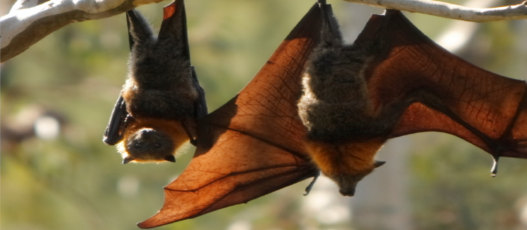
Where are most fruit bats native to? In Africa, these animals are mainly found in tropical and subtropical regions, where there is plenty of food and hiding places for them. Like bats, they are mainly crepuscular or even nocturnal, depending on the species of fruit bat. It is not uncommon for fruit bats to travel long distances in search of food and only return to their roost at sunrise. Although these animals spend the day hanging upside down, like bats, they usually do so in trees and not in caves.
Difference to Bats
Another point that distinguishes fruit bats from bats is that they do not use echolocation but rely on their well-developed eyes and keen sense of smell. The animals usually live together in large colonies that can comprise over 500,000 individuals; for this, they have naturally developed complex social behavior. Other species of fruit bats, especially the smaller ones, are more solitary and only gather for mating.
Appearance
What are the visual characteristics of fruit bats? First of all, the sometimes large wingspan should be mentioned; this can be up to 170 centimeters in some species. The flight membrane is stretched between the elongated finger bones, as is usual in bats, and even extends to the feet. Finally, an important feature of fruit bats is the sometimes large claws located on the second finger of the elongated hand. Almost every species of fruit bat has such claws, which are suitable for climbing in the treetops.