
Falcons
Falcons belong to the birds of prey (Falconiformes) and within this group to the family of falcons (Falconidae).
Characteristic features of falcons
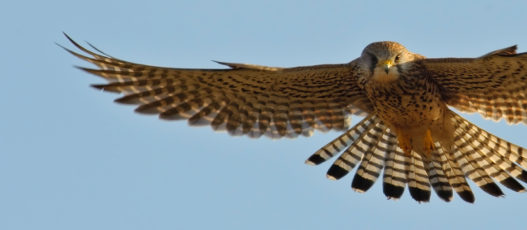
Falcons are small to medium-sized with long, pointed wings and a long narrow tail and have relatively large eyes. Falcons do not build their own nests, but use nests of other bird species or breed in cavities in rock faces or buildings. Falcons prey on small mammals, reptiles or birds, which they spot from the air and may pursue over long distances before killing them with a bite to the neck.
When hunting for prey, falcons benefit from having a field of vision of 220 degrees due to their widely spaced eyes. In addition, they are able to rotate their spine by 180 degrees thanks to anatomical peculiarities – falcons have a total of 15 neck vertebrae. Falcons have also always been of great importance to humans. They have been and still are traditionally used for hunting, but to do so you must pass a falconry examination. Owning a falcon was also a status symbol and remains particularly popular in Arab countries to this day.
Falcon population
Falcons are not threatened as a species and are relatively common. Their population can therefore be considered stable.


