The population of Mali consists of various ethnic groups. These include, for example, the Songhai,
The population of Mali consists of various ethnic groups. These include, for example, the Songhai, Malinke, Senufo, Tuareg, Bozo or the Bobo ethnic group. Around 85 percent of Mali’s population are considered followers of Islam. In addition, there are also some Christians and animists. Due to Mali’s ethnic diversity, the country is home to a variety of languages, such as Bambara, Songhai, Dogon, Tamasheq, Soninke, Fulfulde, Hassaniya Arabic, Bobo or Senufo. French is the official language of Mali.
Sights in Mali
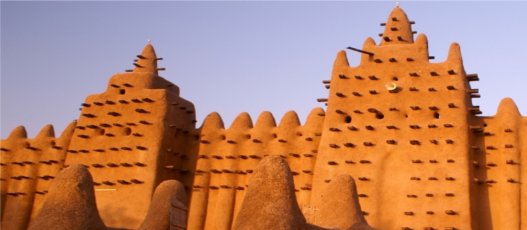
One of the sights in Mali is the impressive mosque in Djenné. This mosque and many other buildings in the city were constructed from mud. Djenné was one of the most important cities in the region due to its location on the Trans-Saharan trade route. In Bamako, Mali’s capital, visitors can learn about the country’s culture at the city’s National Museum.
Other notable places in the country include Timbuktu. In the 15th century, this city was one of the major centres of the salt and gold trade. Today, the city is no longer wealthy, but Timbuktu still boasts numerous mosques and other historical sights. In La Boucle du Baoulé National Park, visitors can also discover Mali’s wildlife in its natural habitat. The fauna here includes, for example, hippopotamuses, giraffes or buffaloes.
Location and Climate of Mali
Mali is located in West Africa as a landlocked country bordering Algeria, Niger, Mauritania, Ivory Coast, Burkina Faso, Senegal and Guinea. Around 60 percent of Mali’s land area is covered by the Sahara. In the northern part of the country lie the foothills of Algeria’s Ahaggar Massif. In addition, there are also some oases in the northern desert landscape along the former Trans-Saharan trade route.
Mali’s climate can be divided into two zones. In the northern part of the country, in the Sahara region, there is a dry desert climate. Temperatures in this region can reach up to 40 degrees Celsius during the day in January. At night, however, temperatures can drop to as low as 10 degrees Celsius. Rainfall is very rare in the north of the country. In southern Mali, on the other hand, there is a predominantly hot and humid climate. Temperatures in the south are pleasant all year round. In summer, temperatures reach up to 30 degrees Celsius, and this is also when most rainfall occurs.
Arrival and Entry
Mali’s international airport, Sénou International Airport, is located about 15 kilometres from Bamako, the country’s capital. It is also possible to reach Mali by car or bus. There are various border crossings to all neighbouring countries. However, travellers entering by their own vehicle require a ‘Carnet de passage’.
German tourists require a visa to enter Mali. This must be applied for before departure with a passport that is valid for at least six months. The passport is also required for children travelling with you. However, children under the age of 16 can enter if one parent is still listed in the passport. In addition, all travellers must provide proof of a valid yellow fever vaccination. This requirement does not apply to travellers under one year of age.