Around 1.9 million of Ghana’s total population of 22.5 million live in the capital Accra. The majority of Ghana’s population, at around 40%, follow African traditional religions.
Around 1.9 million of Ghana’s total population of 22.5 million live in the capital Accra. The majority of Ghana’s population, at around 40%, follow African traditional religions. In addition, the country is home to followers of many other religions, including Christians, Baptists, Muslims and Presbyterians. Due to the population’s diverse ethnic backgrounds, many languages are spoken in Ghana, such as Ewe, Ga, Akan and many more. The official language of Ghana is English.
Attractions in Ghana
The area of Ada, located at the mouth of the Volta River, is a popular holiday destination with the Songow Lagoon, ample fishing opportunities and a rich variety of birdlife. The town of Aburi in the Akwapim Hills is also a popular travel destination in Ghana. The climate in this mountainous region is particularly pleasant, and as early as the 19th century, a sanatorium was established here, which today serves as a rest house. The town also features a large botanical garden with many subtropical trees and plants.
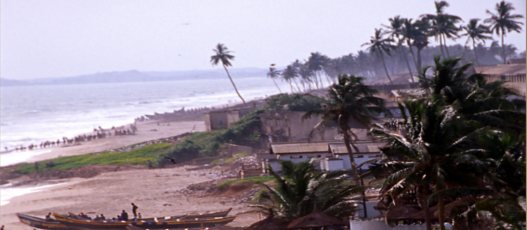
On Ghana’s west coast, there are many palm-fringed sandy beaches along the Atlantic Ocean. However, swimming is only safe in the many small protected bays, as the waves of the Atlantic are very high in this region and the currents are sometimes very strong.
In addition, Ghana has many national parks that protect the country’s diverse flora and fauna. One of these national parks is Mole National Park. This park can be explored by off-road vehicle or on foot. There are also accommodation options directly within the national park. Visitors can observe many animal species, such as elephants, antelopes, buffalo, warthogs or monkeys in their natural habitats from close proximity.
Location and Climate of Ghana
Ghana is located in West Africa, bordered by Togo to the east, Burkina Faso to the north and Côte d’Ivoire to the west. To the south, Ghana borders the Atlantic Ocean, specifically the Gulf of Guinea.
The country has a humid tropical climate with warm temperatures year-round. In Accra, for example, temperatures remain around 30°C throughout the year. The weather is shaped by dry and rainy seasons. In northern Ghana, the dry season lasts from roughly November to April, followed directly by the rainy season until about September. In the south, there are two dry seasons. The first lasts from July to August, and the second from December to April. The rainy seasons in the south are very pronounced. The first rainy season lasts from May to June, and the second from September to November. For the entire country, the months from November to February are considered the best time for a holiday in Ghana.
Arrival and Entry
Ghana’s international airport is located in Accra, about ten kilometres from the city centre. The country also has two deep-sea ports and border crossings with all neighbouring countries, making travel by bus or car also possible.
For entry into Ghana, German nationals are required to present a valid passport and a visa. Such a visa can be applied for at the country’s embassy. At the consulates, only business visas can be applied for. In addition, all travellers aged one year and older must provide proof of a valid yellow fever vaccination.